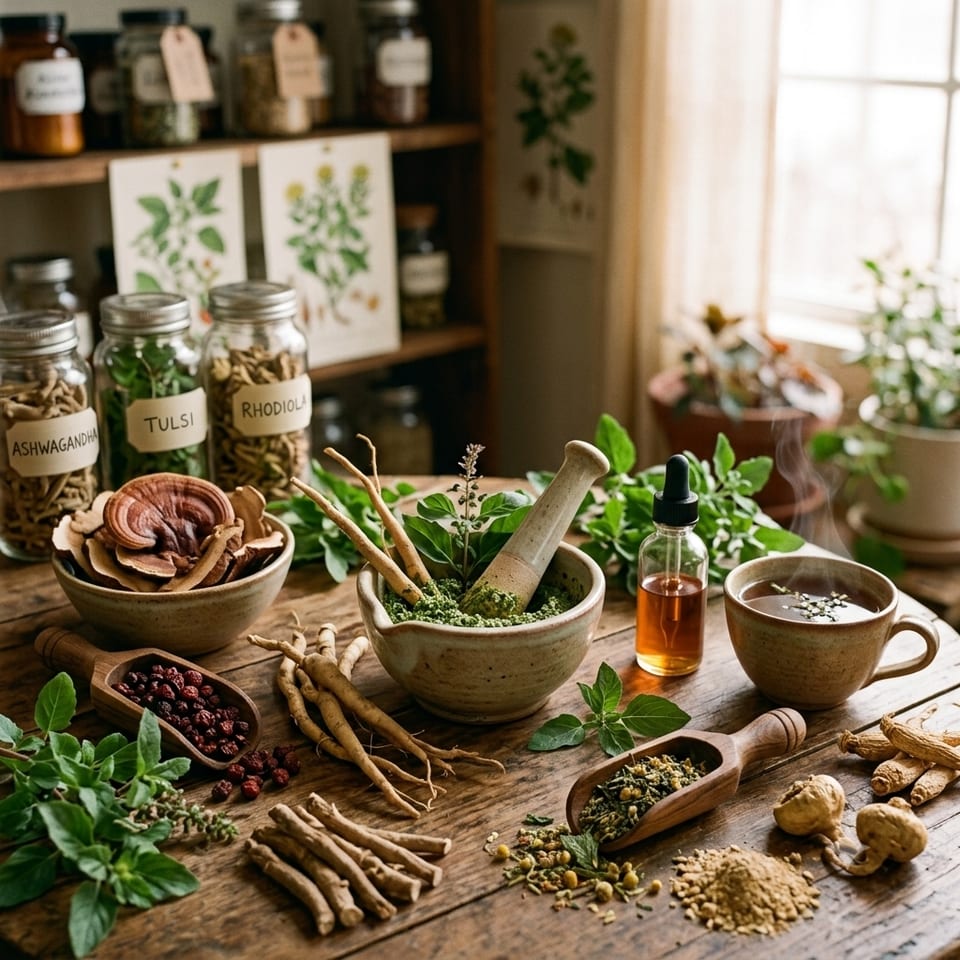
If you have spent any time around herbs lately, you have probably run into the word “adaptogen.” It shows up on tea tins, tincture bottles, and wellness blogs, usually promising calm, energy, and balance all at once. So what is an adaptogen, really — and is it worth the attention?
So, what is an adaptogen?
An adaptogen is a plant traditionally believed to help the body adapt to stress. The idea is simple and a little poetic. Instead of pushing you up the way caffeine does, or pulling you down the way a sedative does, an adaptogen is thought to help you find your middle — to nudge the body back toward balance, wherever it has drifted.
Herbalists usually describe a true adaptogen by three qualities: it is gentle enough for regular use, it helps the body handle many kinds of stress, and it works without yanking you hard in any one direction. That gentleness is really the whole point.
An old idea with a modern name
Though the word sounds new, the plants are ancient. Long before anyone coined a term for them, the Ayurvedic tradition of India prized herbs like ashwagandha as rasayanas — rejuvenating tonics — and holy basil, or tulsi, as a plant to steady the mind and spirit. Traditional Chinese Medicine leaned on ginseng and schisandra for much the same reasons.
The word “adaptogen” itself is younger. It came out of the mid-1900s, when researchers went looking for plants that might help people hold up under extreme stress and fatigue. Much of that early work centered on rhodiola and ginseng, and it gave us the framework we still use today.
How they are thought to work
Here is where we stay honest: the science is still growing, and we are careful not to overpromise. But researchers believe adaptogens interact with the body’s main stress system, sometimes called the HPA axis — the loop between your brain and adrenal glands that manages stress hormones like cortisol. The thinking is that adaptogens help smooth out that response, so stress lands a little softer and you recover a little quicker.
People who use them often describe feeling steadier — less frazzled, a bit more focused, more like themselves on a hard day. Nothing dramatic. More like a floor under your feet.
A few adaptogens worth knowing
- Ashwagandha — perhaps the best known, traditionally used to ease tension and support a calm, steady mood.
- Holy Basil (Tulsi) — a beloved Ayurvedic herb, traditionally used to quiet a busy mind and lift the spirits.
- Rhodiola — a hardy mountain plant, traditionally reached for to push back against fatigue when life feels demanding.
- Eleuthero (sometimes called Siberian ginseng) — long used to support stamina and endurance.
- Ginseng — a classic tonic, traditionally used for energy and vitality.
- Reishi — a revered mushroom, traditionally used to support the immune system and a sense of calm.
- Schisandra — a five-flavor berry, traditionally used to support the liver and steady endurance.
- Maca — a Peruvian root, traditionally used for energy and hormonal balance.
How to actually use them
Adaptogens are not a quick fix, and anyone who tells you otherwise is probably selling something. They tend to work quietly, over weeks of steady, daily use — more like a garden responding to consistent watering than to one big flood. Give a new adaptogen two to four weeks of honest, regular use before you decide what you think.
Tea and tinctures are two of our favorite ways to take them. A daily cup is gentle and easy to stick with, and a tincture is quick when the day gets away from you. Several adaptogenic herbs are woven through our blends — you can explore our adaptogen remedies or browse the whole herb collection any time. If you are not sure where to begin, reach out and we will help you find or build a blend that fits your days.
A few honest cautions
Gentle does not mean “for everyone.” Some adaptogens are not appropriate during pregnancy or nursing, and some can interact with medications or affect conditions like thyroid or blood pressure. Please talk with your doctor before starting one, especially if any of that applies to you. Adaptogens are a support for a healthy life — never a replacement for real medical care.
A note on wellness: These statements have not been evaluated by the FDA. Our products and articles are for general wellness and educational purposes and are not intended to diagnose, treat, cure, or prevent any disease. Always talk with a qualified healthcare provider before using herbal products, especially if you are pregnant, nursing, taking medication, or managing a health condition.