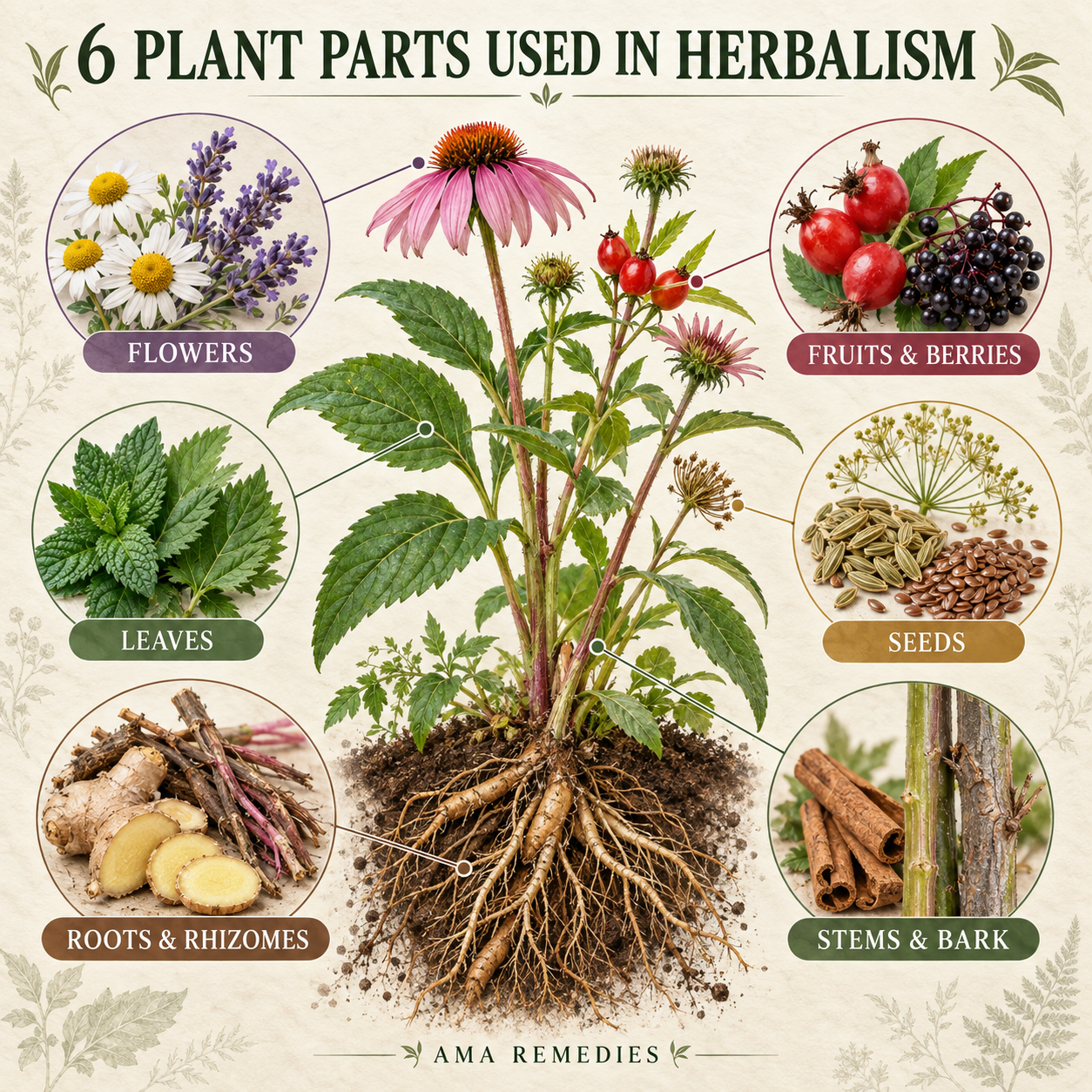
When most of us picture an herbal remedy, we imagine a leaf steeping in a cup or a bright flower drying on a windowsill. But a medicinal plant is far more than its prettiest part. From the roots buried deep in the soil to the smallest seed on the stalk, a single plant is a whole apothecary — and each part carries its own compounds, its own gifts, and its own best moment to be gathered.
Knowing which part to reach for, and when, is one of the quiet secrets of good herbalism. Here is a friendly tour of the six parts of a medicinal plant, what each one offers, and why timing matters so much.
1. Roots & Rhizomes — The Deep Reserves
Roots anchor a plant and draw up its water and nutrients. Rhizomes are underground stems — think of ginger — that store energy and compounds horizontally beneath the surface. Together they act as the plant’s pantry, holding the richest concentrations of alkaloids, starches, and minerals. That density is exactly why roots are so often chosen for deep, long-term support.
When they’re gathered: usually in late fall or early spring, once the plant has pulled its energy down out of the leaves and flowers and tucked it away below ground.
A few to know: echinacea for immune support, ashwagandha for helping the body adapt to stress, and ginger for digestion.
2. Stems & Bark — Structure and Protection
The stem gives a plant its structure, while the bark is the protective outer layer of trees and woody shrubs. Because bark is the plant’s own armor, it tends to be rich in tannins — astringent compounds that gently tighten and tone tissue — along with soothing, anti-inflammatory constituents.
When it’s gathered: from older branches during the dormant season, in winter or late fall, when the sap has drawn down and the protective compounds are most concentrated.
A few to know: cinnamon bark, prized as an antioxidant and for blood-sugar support; wild cherry bark, a traditional friend for coughs; and willow bark, whose salicin is the plant-world ancestor of aspirin.
3. Leaves — The Sun’s Workshop
Leaves are where sunlight becomes life. As the site of photosynthesis, they are often packed with vitamins, chlorophyll, and the fragrant volatile oils that give so many herbs their character.
When they’re gathered: in the mid- to late-growing season, ideally just before the plant flowers, when the foliage is vibrant and the plant’s metabolism is running at full tilt.
A few to know: peppermint for digestion and its bright essential oils, nettle for its remarkable mineral content, and plantain, a humble backyard leaf long used to soothe and support the skin.
4. Flowers — Aroma and Ease
Flowers are the plant’s reproductive heart — vivid, delicate, and often intensely aromatic. Many are cherished for their gentle, calming effect on the nervous system.
When they’re gathered: in mid-summer, once fully open but before they begin to fade, when their fragrance and potent oils are at their peak.
A few to know: chamomile for calm and restful sleep, lavender for easing everyday tension, and arnica, used externally for bumps and bruises.
5. Fruits & Berries — Sweet Protection
A fruit or berry is the ripened ovary of a flower, usually cradling the seeds within. Nature wraps that precious cargo in color and sweetness — and in a wealth of vitamin C, bioflavonoids, and antioxidants that help defend the body against everyday free-radical wear.
When they’re gathered: at full ripeness, typically in late summer or fall.
A few to know: elderberry for immune support, rose hips for their generous vitamin C, and hawthorn berry, a time-honored ally for the heart and circulation.
6. Seeds — Small but Mighty
A seed holds everything a plant needs to begin again, which is exactly why it is so nutrient-dense. Seeds are often rich in beneficial fatty acids and concentrated compounds, all packed into a tiny package.
When they’re gathered: in the fall, once thoroughly dried and mature, after the fruit has ripened or dried on the plant.
A few to know: flaxseed for omega-3s and fiber, fennel seed for digestion, and cardamom, an aromatic spice that doubles as a digestive aid.
A rhythm worth learning
Notice the rhythm running through all of this: the plant moves its energy through the seasons, and the herbalist simply follows along. Roots in the cold months, leaves and flowers in the warmth, fruits and seeds as the year winds down. Learning that rhythm is what turns a casual admirer of plants into a thoughtful practitioner.
So the next time you meet a plant, try asking two simple questions: Where is its energy concentrated right now? and What is this part’s job? The answers will point you toward the part worth using — and deepen your friendship with the plant world along the way.
Every AMA remedy begins with this same kind of attention: the right part, gathered at the right time, and blended by hand. Explore our herb collection to meet these plants one by one, or build your own custom blend and put a little of this wisdom to work in your own cup.
A note on wellness: These statements have not been evaluated by the FDA. Our products and articles are for general wellness and educational purposes and are not intended to diagnose, treat, cure, or prevent any disease. Always talk with a qualified healthcare provider before using herbal products, especially if you are pregnant, nursing, taking medication, or managing a health condition.